Showing posts with label Review. Show all posts

Thursday, 29 June 2023

Review - Paul Brookes - These Random Acts of Wildness / Othernesses

Review - Paul Brookes - These Random Acts of Wildness / Othernesses


Paul Brookes is a writer, local historian, genealogist, photographer, shop assistant and grandfather. He is editor of the Wombwell Rainbow interviews, reviews and poetic challenges, and has many published poems and several chapbooks. For more, go to www.thewombwellrainbow.com. 

--------------------------------------------------------------------------------------------------------

Paul has published these two books of poetry simultaneously. They are a result of writing a sonnet a day, inspired to do so by fellow Barnsley poet Ian MacMillan. Sonnets are not straightforward, but they sit nicely in the Venn diagram of narrative, lyric and imagistic and, when used skilfully, can be a powerful weapon in the poet's arsenal. You can tell a story, but it can't ramble. It can be all imagistic, or employ images within it. It can be used as a snapshot that encapsulates an idea. In these publications we see how Paul uses this form in multiple ways.

I am reviewing these together (at Paul's request) as they are linked. I will begin with "These Random Acts of Wildness", a set of 38 poems that are grouped by mini-themes. Nature, housework, childhood and school, and observations in a churchyard. The last group, each describing the life of people randomly next to each other in the graveyard, are a conclusion of the theme of death that runs through the other sections and is signalled by the angel statue beautifully illustrated by Jane Cornwell on the front cover. Randomness is a theme too, and as humans our desperate attempts to find some sort of order to the chaos of the world.

There are many excellent poems here - I like "Cemetery Swallows" - a poem about life and death intertwining and life continuing after we go. 

Flash their white underside as they curl in
wards, vital boomerangs spinning back on
themselves, snatch flitting small meals in a spin


I identify very much with Paul's memories of schooldays in a working class area where being clever and shy made you an outsider.   

Our parents want, work towards best for us.
We are separate in distinctiveness.

The descriptions of the mundane are very good, inhabiting the soul of the vacuum cleaner and iron, observing nature at a microscopic level.

This is a fabulous collection that requires, and deserves, multiple readings. It uses plain language, including dialect where needed, but also stretches into difficult and complex images. 

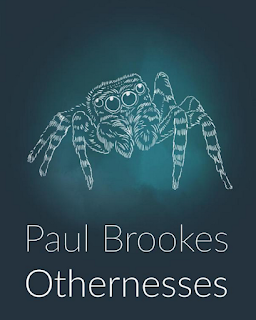
Othernesses is a companian piece that is published by, and contains, beautiful drawings by Jane Cornwell. The combination of sonnets and art is terrific and adds to what is a superb collection of poems. Many of them are about insects, or sea life, and introduce us, briefly, to the brief lives of these creatures that share our planet. Despite being all around us, they are strange, they are "other". We don't really understand how they think, or what drives them other than some nebulous concept of "instinct". We, as supposed higher beings, are always thinking about everything and believe we make most of our decisions after considered thought. Perhaps this collections suggests we don't - viewed on a larger scale our lives are brief. We search for food, sex, perhaps some kind of fulfilment, and then we die.

'Earwigs' is a good example - it shows the birth, upbringing and eventual leaving of the nest of this familiar insect (or is it familiar? - when was the last time I saw one? I used to see them all the time as a boy. Maybe I've stopped looking.) It refers to the female as "Mam", which is a great way to draw you into the poem.

We crawl out of our eggs and eat them
Mam guards us against those who would eat us,
feeds us what she's caught or found, dead stems,
hard and soft shelled, rotted out of darkness.


As a side note, this stanza shows us the effort Paul puts into his rhymes - this is a pattern throughout the book. The mix of full and half rhymes keeps the poems from sounding the same. 

This mother is cruel - she will kill and eat any young who don't leave so she can move on to the next brood. While this is extreme, there will be people who recognise this rejection if their mother finds a new man, a new family. 

Even home is temporary. All fleet.
I hide in darkness, wings folded and neat. 

Someone asked the other day to define poetry as opposed to just speaking or writing. This book would be a fantastic example. I replied as a quick and incomplete response - "rhythm, concise language, pointing out things that people may not otherwise see, but recognise."

Just when you think Paul has created a complete collection of insect sonnets like some Victorian collector, pinning them one at a time onto a board, he throws in some poems about him, his ancestors, and indeed ourselves.

There are about 70 sonnets in "Othernesses" so it takes time and multiple readings to absorb them all. Along with "These Random Acts of Wildness" they form a formidable collection of beautifully constructed fourteen liners (one or two may be shorter!). Vivid, detailed, and interesting. Get them both if you can.


"These Random Acts of Wildness" is published by Glass Head Press and is available directly from the author. Contact Paul on Twitter @PaulDragonWolf1 or by email paulbrookes07@gmail.com

"Othernesses" is published by Jane's Studio Press


Friday, 16 June 2023

Review - Sally Jenkinson - Pantomime Horse, Russian Doll, Egg

Review - Sally Jenkinson - Pantomime Horse, Russian Doll, Egg


Sally Jenkinson was born in Doncaster, South Yorkshire. She has been writing and performing poetry across the UK for more than a decade, and has also written and performed internationally in Sweden, Iceland and Australia.

Her work has recently been featured in The Morning Star, Lighthouse Journal, Emerge Lit Journal, The #MeToo Anthology from Fairacre Press, and on BBC Radio 4’s ‘Power Lines’.

She is a care worker and community arts producer, and is currently working towards her MA in Creative Writing from the University of Gloucestershire.

--------------------------------------------------------------------------------------------------------

I recently reviewed Helen Mort's "The Illustrated Woman", which was a broad ranging look at women and how they and others viewed their bodies. Part of it was about childbirth, but in this pamphlet Sally does a deep dive into her specific childbirth experience, in all its gory, frightening and magical detail. Reading this I felt at times a bit like Ewan McGregor's character in Trainspotting when he goes into the filthy toilet to get his drugs. I felt like I was going head first into a birthing pool, drowning in various fluids, to get to the poetry. I, of course, have never experienced childbirth in person and I did miss our first (I was in America for work and he decided he wanted to come 4 weeks early) but the other two were relatively routine once we'd reached the hospital. Actually I really must write about the journey to Jessop's on 29th January 1990 - but that's for another day, get back to the review!  

It starts with the early stages, with a prose-poem "Pantomime Horse" that uses the stages of labour as a start point for short prose pieces that poetically reflect the very matter-of-fact descriptions of each stage of birth. 

Then the setting up of the birthing pool. In the very short poem Birth Plan (this is most of it), Sally writes

I hope to do this at home
because hospitals are choked with ghosts

Spoiler alert - the home birth plan is thwarted and the poem Hospital Transfer explores the moment that the plan changes.

No bone-old fears can compare to this.

Wagons roll
says the parademic.

In hospital the poems become increasingly frantic, giving a sense of disorientation and hallucination as memories mix with the reality of the situation the soon-to-be mother is in. The poem Forensics breaks out of the panic and views some less than pleasant memories of men, as the doctor reaches between her legs. I won't spoil the ending, but the last line of this one is very sharp indeed. 

Once the baby is out safely the poems soften and the final one, The Goddess Myth, is a lovely reflection of the joy and relief. 

Your tiny hands, your tiny ears, your tiny wail
                I won't write a poem for another year
You're the best thing I've ever made
    One day you'll ask me a question I can't answer


This isn't an easy read and it may be best to avoid it if you're about to give birth for the first time. Save it for afterwards. It's full of brilliant images and swaps poetic styles and rhythms effortlessly. the poems change shape; there are found poems, imagistic poems, narrative and lyric, and there's even space for a Golden Shovel. 

This is a very creative and visceral work, a fine poet writing about her experiences in a vivid and challenging way. Highly recommended.

"Pantomime Horse, Russian Doll, Egg" is published by Burning Eye Books www.burningeye.co.uk


Tuesday, 9 May 2023

Review - Matthew M.C. Smith - The Keeper of Aeons

Review - Matthew M.C. Smith - The Keeper of Aeons


Matthew M. C. Smith is a Welsh writer from Swansea. He is a three times-nominated 'Best of the Net' writer (Icefloe Press 2020, Acropolis Journal 2022 and Broken Spine 2022), a Pushcart Prize nominee (Broken Spine 2022) and R.S. Thomas prize winner (Gwyl Cybi). Matthew is widely published in presses such as Poetry Wales, Barren Magazine, iambapoet, The Lonely Crowd, Icefloe Press, Arachne Press, Finished Creatures and Broken Spine Arts.

Matthew published Origin: 21 Poems in 2018 and The Keeper of Aeons in Autumn 2022.

He studied for a PhD on the subject of Robert Graves and Wales at Swansea University, completing this in 2006. He is academically published in the International Journal of Welsh Writing in English.

​Matthew writes about landscape, history, identities, family and cosmology.

He is the editor of Black Bough poetry, a project created in 2019 to promote imagist micropoetry. He is the originator and organiser of  weekly poetry fest @TopTweetTuesday on Twitter and the Silver Branch  that platforms amazing writers.

-----------------------------------------------------------------------------------------------------------------------------

The Keeper of Aeons is a wide-reaching, evocative and ambitious combination of prose and poetry that, as its title suggests, spans our past and future via a brief interlude in the life of a young Matthew Smith.

In the short, one poem, prologue the observer in the International Space Station looks down and wonders if love exists outside that orbit. And indeed, what love even endures on that globe?

Part One, Aeons, is also short. It looks at the past and future, sets the scene for the rest of the collection. Bones of ancient people in a museum, astronauts stepping into a gleaming rocket.

Part Two, Ancient Navigations, takes us through the ages via the ancient caves, crags and bones of Wales. There are so many fabulous images here that it's hard to pick examples. In fact I opened pages at random and stuck my finger on a poem or prose piece and pulled out these:

Fires danced, shadows on the hill,
Tongues lost before bones 
  (Bryn Celli Ddu)

Flies scud in half-light
glint in glacier-ruins
where minnows flicker
in golden shadows  
(Henrhyd Falls/Annwn)

The rich, dense imagery is like a jungle of words, almost overwhelming in its fecundity. But once you start picking your way through you find so much to love. There are echoes here of two Thomases - Dylan and R.S. - unsurprising perhaps as almost every Welsh poet will have them in their DNA. Yet Matt's writing is also like neither of them.

There is a deep affection and reverence here for landscape and history, a feeling that the stones, paths and hills are somehow alive, or at least that they hold some part of every living thing that has touched them.  

One of my favourites is the long prose piece 'Fixing the Hyperdrive' - it takes us briefly from the ancient to the (relatively) modern with a boy and his love of Star Wars and his ability to use a second hand Millennium Falcon to fire his imagination. There are lovely memories of early 1980s childhood in this poem, and it grounds us before the leap into part three of the collection. But of course, as with earlier references to rockets and space, it points us to where we are going.

Star Fields vividly brings back my memories of looking at the Milky Way in the pitch dark skies of Northern Queensland. The sheer scale, that humbles you and makes you question the meaning of existence. 

Part Three, Heaven's Territories, takes into a distant future where things may not be as gleaming as the rockets that we fire towards the equally luminous stars. The future is consequential, but it is not yet written. 

The concluding poem, 'What is Faith?' begins

It is knowing that nothing matters
that there is nothing else

but the dance of dust
around our bodies

and the speed
of light, impossibly fast

and far, which knows
no pain, an arrow without sentience.

Again, this section contains remarkable imagery, but the poems are shorter, more concise, taking us to a conclusion in style. 

This collection is a technical tour de force in imagistic prose and poetry that achieves its very ambitious target to take us on a journey through time and space unlike no other.  He should be very proud of this - now the question is - where does he go from here? I can't wait to find out. 


'The Keeper of Aeons' is available from The Broken Spine website.


Tuesday, 28 March 2023

Review - Helen Mort -The Illustrated Woman

Review - "The Illustrated Woman" by Helen Mort


Helen Mort is an award-winning author based in Sheffield. She has published full collections of poetry, a novel and also writes drama and creative non fiction. She has been shortlisted for the T.S. Eliot Prize and Costa Prize and won the Fenton Aldeburgh Prize in 2015. She is a Senior Lecturer at Manchester Metropolitan University.

At a more personal level for me, she was Derbyshire Poet Laureate and founded the Spire Writes poetry night in Chesterfield, which I attend. 

Helen came as guest reader to Spire Writes in 2022 to read from her latest collection, The Illustrated Woman. 

This is a superbly crafted collection, full of concise writing, by turns gentle, fascinating, disturbing, challenging and occasionally wry and humourous. The title and the front cover give a hint about the overall theme of the novel, and the visual images that certainly drive the first section, "skin". Helen herself has a number of tattoos (although not as many as on the cover illustration!) and, through these, she explores her own identity and that of women in general. In particular, she references the women who came before her - her mother, grandmother and her great-grandmother. In the beautiful poem "Precious" she describes the ring that has been passed between those women, wrapped around each of those fingers:

Birmingham bright, silver of the Jewellery Quarter
this ring is the ribcage of my great grandmother,

is the concrete pipes on the building site
where my gran played chicken as a child...

The poems in this section explore society's views of women with tattoos, both now and in the past. Helen writes from a deeply personal perspective yet skillfully brings that perspective to people who aren't inked themselves.

I have to admit a personal liking for a poem in this section, "Love Poem" that is set on the Chesterfield Canal that is not directly linked to tattoos, unless you count painting Fuck Off on a wall as a kind of tattoo. I have walked and run there many times and the images are perfect. 

"The Nurse" describes an exquisitly British awkward moment in a clinic as blood is taken.

"On Permanence" is a fabulous prose-poem that closes the section perfectly, explaining without explaining. 

The second section, "skinless" takes us on a journey though childbirth and the joys of small children. In "Pip", there's this fabulous stanza

I placed my hand on my stomach
as if I could already feel the growth
inside me, tiny as an orange seed,
a burrowed pip, near-weightless, citrusy.

"Into the Rucksack" takes us to the world of the dad-to-be classes, a sharp piece aimed at men clumsily attempting to empathise with pregant women. 

There are so many lovely natural images in this section once it gets to and past the birth - sheep, owls, bears, berries. Too many to even pick a fair selection to show you. Towards the end of the section things turn a touch darker, a portent of what's to come.

The last section, "skinned" opens with a brutal, unadorned sequence called "The Valley" about the porn industry in the US - some of the participants are tattooed, but everything is exposed. The sad story of August Ames, the brutality of the casting couch, the mundane grimness of the porn shoot.

August Ames was found hanging from a tree in LA, a day after getting bullied off social media for refusing to participate in a sex scene with a man who had done gay porn (I had to look this up). 

Helen had her own horrific experience with online deep fakes and she covers this expertly in "Deepfake: a pornographic ekphrastic". After these two poems have metaphorically punched you in the gut there's a long prose (prose-poem?) piece about an expedition in the wilds of Greenland. It's empty, beautiful, unsettling and a place the writer can almost, but not quite, escape from the turmoil back home.

Perhaps you have often felt yourself watched. Perhaps you were right. 

From a distance you might think she was enjoying herself

The poem Clematis Montana is a heartbreaking poem about her mother - she used to catch little Helen out with the which is heavier - a tonne of bricks or a tonne of feathers? riddle.

She'd laugh. There's no difference. Now her limbs
are tricking her. Her body was a house.
Now it's made of feathers.

The rest of the poems are more reflective and the collection ends with the flawless, tender, love (in its purest sense) poem "Dear Body", that circles back round from "Precious". It describes Helen helping her mum to shower. Their bodies, their skin, reconnecting as they did when Helen was a child. Beautifully written.  

Close up, her skin more tanned
than mine, a dark mole

growing on her temple
right where my grandma's is

her elegant, arthritic hands,
garden-blunt fingernails.

The whole collection deserves multiple readings - on each read through you find a line, an image, a thought that eluded you before. It is a serious piece of work, thematically very solid, technically excellent and extremely thought provoking. 

"The Illustrated Woman" is published by Chatto & Windus and is widely available online.  

Tuesday, 28 February 2023

Review - Sarah Wimbush - Shelling Peas with My Grandmother in the Gorgiolands

Review - "Shelling Peas with My Grandmother in the Gorgiolands" by Sarah Wimbush


Sarah is a Leeds based poet who grew up in Doncaster. She grew up in a mining community and also has Romany heritage. In her first full collection, she dips into both of these traditions and pulls out some gorgeous memories, scattered with Yorkshire dialogue and (thankfully translated) Romany words. 

The list of her publications and prizes is far too long to reproduce, and they are well deserved.

The collection is split into two parts, the first being a series of poems that touch on all aspects of Romany life, or at least a life that perhaps has disappeared now. Food and nature feature prominently, as indicated in the title of the collection, as does trading and interacting with the gorgios (non-Romany). But this is primarily about people, about culture. It's a world that seems familiar yet alien. A parallel culture. There are so many great examples I could quote but here are a couple of snippets that I think represent these poems. 

In "The Calling Basket" Sarah describes the basket carried door to door by Romany women containing items to sell to the gorgios.

Black velvet trim for mourning mantles are long-tails.
Mother-of-pearl buttons are a pair of lost souls.

The ending is perfect:

                                    And gorgios
          who hide behind lock and book and jacquard curtain -
          the young monisher who buys a bud of lace,
          her rush to cross my palm with brass.

Monisher is the Romany word for woman. You can find a video of me reading this poem here

In the title poem the Grandmother dispenses a range of advice both dubious and sensible:

                            Never tell anyone
                    when the visions come, that you collect dead

            women's earrings.

            Never smoke a pipe until you're at least ten.

There are tales of travelling, of the fear of being held in one place, distrust of outsiders, the making of a meat pudding, the cooking of a hedgehog. These things are in Sarah's blood and she tells them with both passion and clarity.

In the second part the collection shifts to the world of South Yorkshire in the 1970s and 1980s. This culture may be as alien to some of you as the Romany world is, but not to me. I grew up in the neighbouring coal fields of Derbyshire, and Sarah absolutely nails the period, the place, and the people.

There are very serious poems here but also humour - Inside Lingerie is a very funny description of men hanging around in a department store waiting for their wives to buy underwear.  

Just as the first half finishes with "Bloodlines", a poem that encapsulates that part of the collection, part two finishes with the brilliant prose-poem Our Language.

            This is the language of the pony riders and
            jumped-up checkweighmen, of Davy lamps and Dudleys,
            the oncostlads and gaffers, of black-nails and snap-tins, and
            names like Arthur passed down through time till it's more
            than a name, it has new meaning like the word GIANT
            or STONE. 

The poem I would pick out from this half is The Pencil Sharpener, a wonderful description of sharpening pencils at school using the little hand wound sharpening machine clamped to the teacher's desk and then Dad sharpening one at home with a knife. The ending of this poem is exquisite. You can listen to Sarah reading it here.

The cultural references are perfect - the £1 Premium Bond birthday gift, the pubs, the race course seen on TV, the miners on the old pit tip.

I could bang on about how technically brilliant these poems are - full of rhythm, images and varying in form from short, sharp poems (one of her pamphlets opens with a haiku), a concrete poem in the shape of a gold earring, to longer prose pieces that draw you in - but I prefer just to read them. And you should too.

Tim Fellows 28.2.23

"Shelling Peas with My Grandmother in the Gorgiolands" by Sarah Wimbush is published by Bloodaxe Books. Buy it here

The Colours of Her Skirt

Based on a memory, which may be unreliable, from some time in the 1960s.  With thanks to Sarah Wimbush and Ian Parks for editing and for the...