Showing posts with label History. Show all posts

Wednesday, 27 January 2021

Finding Them

Written for Holocaust Memorial Day. 


Finding Them

Iron gates, unlocked,
open and creaking.
Buildings, wood
and concrete
containing
only things

they chose
to leave 
behind.

Shoes, spectacles, teeth,
skin and bone.

Everything is hollowed out. 

Tim Fellows January 2021


Photo by Frederick Wallace on Unsplash

Wednesday, 21 October 2020

That Other Child - in memory of the Aberfan disaster

Aberfan, Cymru, 21 October 1966. 144 people, including 116 children died when the spoil heap colapsed and slid onto the village, engulfing the school. The cause was the collapse of a spoil heap from the colliery that was undermined by spring water. Despite the subsequent enquiry putting the blame squarely on the NCB, nobody lost their jobs or was even fined, let alone imprisoned for clear negligence. Lord Alfred Robens, chairman of the NCB and clearly part of the institutional problems that led to the disaster, went on to become the chair of a Health and Safety committee. Originally a Labour politician and union leader, by 1979 he was living a luxurious lifestyle and had aligned with Thatcher's Conservatives. 


That Other Child

Derbyshire, 1966
mum dropped me at the school gates
wrapped against October's chill
She made sure I wasn't late

Another Friday for that boy,
in the shadow of the mine
closed down just the year before;
the pit head stayed, a kind of shrine

or monument to colliers past
the slag heap hill was out of bounds;
too dangerous to climb back then
but meanwhile, as the clock unwound,

other children laugh and play,
sitting in their tiny chairs
never saw their mums again;
just an accident of birth

that they, not I, died on that day
in that pit village, far away.

Tim Fellows 2020

Mynwent Aberfan 

Images from Wikipedia

Friday, 20 September 2019

I Fell at Towton

The Battle of Towton took place during the Wars of the Roses in the spring of 1461. There was heavy snow. It was long and brutal, possibly the bloodiest battle to be fought on English soil.


I Fell At Towton

Red flesh, vivid on splintered bone
where blood flows in angry 
torrent my unseen foe emerges 
through the thickening snow 
that dulls the sound of screams and roars;
mace aloft to strike a cruel blow. 

His eyes a blaze of fear and hate;
his breath in plume
as in a scything, swirling blur 
of arms he aims 

to crush my head, it glances 
from my helmet as I swerve 
but slip and fall where mud 
and gore have mixed with ice 
slick from the snowy squall. 

On the ground I lie and to my right 
a comrade lies, a trace of tears 
frozen on his empty eyes
that stare as once they stared in birth, 
and now must gaze on death. 

A blade is lifted to the sky
and as I await its fatal bite 
I see the snow is settling now 
covering bodies with a shroud of white 
and I can only think that how 
the rose I served must win 
or why else did I fight?

Tim Fellows 2019

Saturday, 17 August 2019

Birth

In February I visited the Pima County Air Museum in Tucson, Arizona. One of many splendidly preserved aircraft was a B-29 bomber, Sentimental Journey, like the one in the image below.


The atomic bomb known as Fat Man exploded over Nagasaki on the 9th August 1945 at 11:02 a.m. at an approximate altitude of 1,800 feet. Less than a second after the detonation, the north of the city was destroyed and 35,000 people were killed. It was delivered by the B-29 bomber Bockscar.


Birth

In the cavernous hangar
the silver beast is silent.
Its belly gapes
and I imagine
Fat Man hanging inside,
primed and bloated
with a deadly load.

The belly is opened and
the beast gives birth,
a bastard child falling,
screaming its first breath
with the light of a thousand suns.
Blistering meagre cloud.
Nagasaki opens her arms
and takes it into her soul.

Tim Fellows 2019

Image by guralski from Pixabay

Wednesday, 7 August 2019

Where Pocahontas Died

The town of Pocahontas in Alberta, Canada, existed briefly for miners to extract coal for the First World War.


Where Pocahontas Died

A wapiti, heavy with calf, is grazing
near the place they called Pocahontas.
Where they came to plunder the treasure
beneath the ground, tracking north through forest
on bear-trails.

The great mountains,
grey faces covered by shrouding cloud
and topped with white,
roared their anger as their hoard
was pillaged. They sent fierce winds and snow
that lay in thick slabs. Tendrils of ice
like frozen tears began to trickle
and formed gushing rivers.

The air and forest blazed with fire
but the precious lode was scoured
until that day when all was empty;
the earth and the ghost shacks, the bones
of another age.

The cow-elk turns mournfully to me, its eyes
dark and wet, then back to gaze upon the place
where Pocahontas died.

Tim Fellows 2019

Image by skeeze from Pixabay

Friday, 25 January 2019

A different take on 'Night Mail'

I wanted to write something to commemorate Holocaust Memorial Day in January 2018 and as it developed I realised it was a bit like W.H. Auden's famous Night Mail so I thought why not go the whole hog and just use it as the whole basis of the poem. It's taken a while to refine it.


You can read the original here but it's worth finding the video on YouTube of it being read on the original film as the different sections scan very differently and are worthy of being listened to in the correct rhythm. 

Night Train 1943

With thanks, and apologies, to WH Auden. 

I
 
This is the Night Train crossing the border
no hindrance thanks to the Fuhrer's order
Carrying the rich, carrying the poor,
the owner of the shop and the girl next door.

Out of the Alps a steady climb
Under this regime she'll arrive on time
In open trucks the people get colder
Rammed like cattle shoulder to shoulder
Scarce sympathy shown as she passes
the silent stations of the huddled masses

People turn their heads as she approaches
Don't look at the faces in the coaches
No-one wants to change her course
despite occasional silent remorse
At night she passes, where no-one wakes
In the carriage a frightened woman shakes

II

A New Dawn rises, the job near done
Down to the ghetto she descends
Towards the town brimming with the sick and dying
Towards the state apparatus, the furnaces
hidden in forests like ancient monsters
The Reaper waits for her.
In far away countries, exalted lands of the free
Families long for news.

III

Letters of hope, pleas for help
words without joy from girl and boy
Filled-out forms, formal invitations,
To live with more fortunate relations
Applications for situations
arising in remote but safer nations.
Letters arrive then suddenly stop
Why would they not write? Why would they drop
the letters from uncles, cousins and aunts
trying to get to Belgium or France
then on to Chicago, Miami, New York
News from Europe increasingly dark
Letters of love, of hope, then fear
from Vienna stained by desperate tear
Written on paper of every hue
by the victimised, robbed and hounded Jew
who cannot bypass the black pen's scoring
as the cold official censors their heart's outpouring
The arm of the fascist state is long
the deafening silence feels so wrong

IV

On the train there's fitful sleep
And dreams of real life monsters
suddenly alive; no friendly waves from neighbours
who sleep safe, for now, in much quieter streets
In ethnically cleansed Munich, Cologne and Berlin
a few remain, continue to dream
and shall wake soon, ten to a room
and none shall hear the fateful knock
without a quickening of the heart
For who can bear to feel themselves forgotten?

Tim Fellows 2018

Friday, 28 September 2018

The Pentrich Rising

Pentrich is a small village on the edge of the Peak District in Derbyshire. These events took place in 1817 when England was in a state of turmoil following the French Wars. Civil disobedience and potential revolution were in the air...

This poem was inspired by the lecture (with music) by John Young detailing the story behind the Rising and its tragic (at least for some) ending.


You can read a full account here

The Pentrich Rising

In eighteen hundred and seventeen
three hundred men and true
marched on the city of Nottingham
to fight to get their due

The Corn Laws raised their prices
They could buy no bread
Cheap labour taking all their jobs
They were hanging by a thread

The government in London
cared nothing for the poor
The bastard Henry Addington
was master of the law

He suspended habeus corpus
he crushed rebellious thoughts
He used his secret agents
and his lackeys in the courts

The men had surely had enough
when they gathered at the inn
They were part of a national movement
that would free their kith and kin

But as they marched together
their problems became clear
No food, no guns or muskets
Not even any beer

They never reached their target
At Eastwood they fell short
The army quickly crumbled
and the ringleaders were caught

There were no other armies
There were no other troops
They fell for Addington's dirty tricks
They were sacrificial dupes

They took them off to Derby
and held them in the jail
They silenced all the protests
no one could tell the tale

They were drawn upon a carriage
to their hanging place
Six thousand saw them struggle
into death's cold embrace

Others were transported
Their sentences reduced
But Brandreth, Turner and Ludlam
faced the hangman's noose

The elite had won the battle
but there was more to do
Fifteen more were slaughtered
in the shame of Peterloo

So remember not to trust the rich -
raise a glass of English Beer
in memory of two hundred years
since the Pentrich mutineers

Tim Fellows 2018

Friday, 3 August 2018

Brother (part one)

I never particularly wanted to write about the 1984-85 strike. I wasn't there. However when an idea comes, it has to be written down and this poem is the first part of a sequence, in different styles, that continues the story.The rest will be published over the coming weeks.


Brother

Brother do you remember
the childhood we shared?
In our two-up two-down terrace;
our dad, tapping out his pipe and
            mam, making chips for tea.

I loved you, brother;
your cheeky smile and hair
never in control
until mam, with a spit and a polish,
            would sort you out.

Cricket in the street -
box for stumps, broken bat
recovered from the bin
at the village club but
dad fixed it for us.
          Although you were younger

You were better than me;
it evened us out so I didn't
have to let you win
although I would have;
          I was your protector.

We were hopeless at school
regularly caned though
it never made no odds.
So at 16, down the pit,
         you followed me and dad.

Ten years passed, hard work done,
but the laughs we had, the jokes
and drunken nights at the club.
Brothers in life and
brothers in coal,
         red in blood and red in soul.

No longer sharing a bedroom;
we had our own kids and homes.
I barely remember a bad
word between us,
        we were best mates and Best Men.

In my mind, clear as day,
that moment when the Union man
told us it was on.
He was so confident that we'd win and
        We will take 'em down again!

And that was us too,
both of us, for weeks and months.
Squashed in cars, making sure
         we kept the scabs at bay.

Then, one day, when I came
to pick up you up you said,
I'm not coming today
I knew straightaway that
         something was wrong.

You wouldn't look me
in the eye. Sarah, standing
in the hall, arms round the kids.
I said "OK" and went alone.
        Day by day my suspicion grew.

I've been punched a few times
but never has it hurt as much
as when they told me
you'd gone back.
       They told me, not you.

I'd have killed you
if mam hadn't been there.
God knows what it would've done
to dad if he'd been alive.
      You were a blackleg, a scab.

On the picket line, shouting
You fucking traitors at the Judas Bus
through a sea of helmets.
That brief moment I saw you;
trying to hide your face.
       I never cry, but I cried that night.

Brother, you've been dead to me
for thirty years -
the childhood bond
was smashed apart.
Those memories must be false
        because I have no brother.

Tim Fellows 2017

Acknowledgement: "Judas Bus" is from the song by Jez Lowe.


Friday, 27 July 2018

Poem of the North - 821 Challenge - "Legacy"

This was my unsuccessful entry to the "Poem of the North" competition. The format is 8-2-1, 8 lines, 2 lines and 1 line, 821 being the classification for English Poetry in the Dewey Decimal system. The theme is "The North" and it must have a turn ("volta") before the couplet.


You can find the winners (including at some point those by my friends Mick Jenkinson and Ian Parks) on the Poetry of the North website


Legacy

The further south I go the more I feel
the warmth around me feeds
the cold within.
The memory of bleak, wind hardened hills
tugs and spins like thread upon a wheel.
A legacy of factories, mines and mills,
harsh injustices galvanized by greed
and the angry cries of my ancestral kin.

Though history informs our common bond
the future can't be smothered by the past.

The time has come to hone our northern steel.

Tim Fellows 2018


Friday, 13 July 2018

Iron

This is a poem about slavery - specifically the slave trade between Africa and the Americas for which we, the British, were responsible. We were part of the triangle that took slaves from Africa to America and the Caribbean then brought back the goods to the UK - cotton, tobacco etc. before restarting the cycle.


Iron

As I lie in this hold with my captive brothers
the iron cuts deep but the hurt is within.
We'll never see our sisters and mothers
or our beautiful homeland ever again.

The ship yaws and rolls, I feel so sick -
in the blackness the shouts, the cries and the moans
seem somehow worse; it's hard to pick
the sounds of my mother tongue over the groans.

There are five hundred souls aboard and yet
we're all so alone; the man next to me stares
into the void - he is covered in sweat,
his mumbling incessant yet nobody cares.

Others, perhaps lucky, have flown to unite
with ancestral spirits, yet I cannot forget
their pain as they died with no honour or fight;
to die without dignity will be my regret.

I was warrior, provider, respected and strong
but these chains make me nothing; they only mock
all that I am, to what I belong.
I'm just on the inventory, part of the stock

I stare at the iron in which I am bound.
Who created this horror? What were they paid?
Did they really not care that far from their land
their intention was only to shame and degrade.

I might die on this ship but yet I might see
those beautiful valleys, rivers and streams.
With no iron chains I am once again free
in that far distant land that lives in my dreams.

Tim Fellows 2017

Friday, 4 May 2018

Orgreave


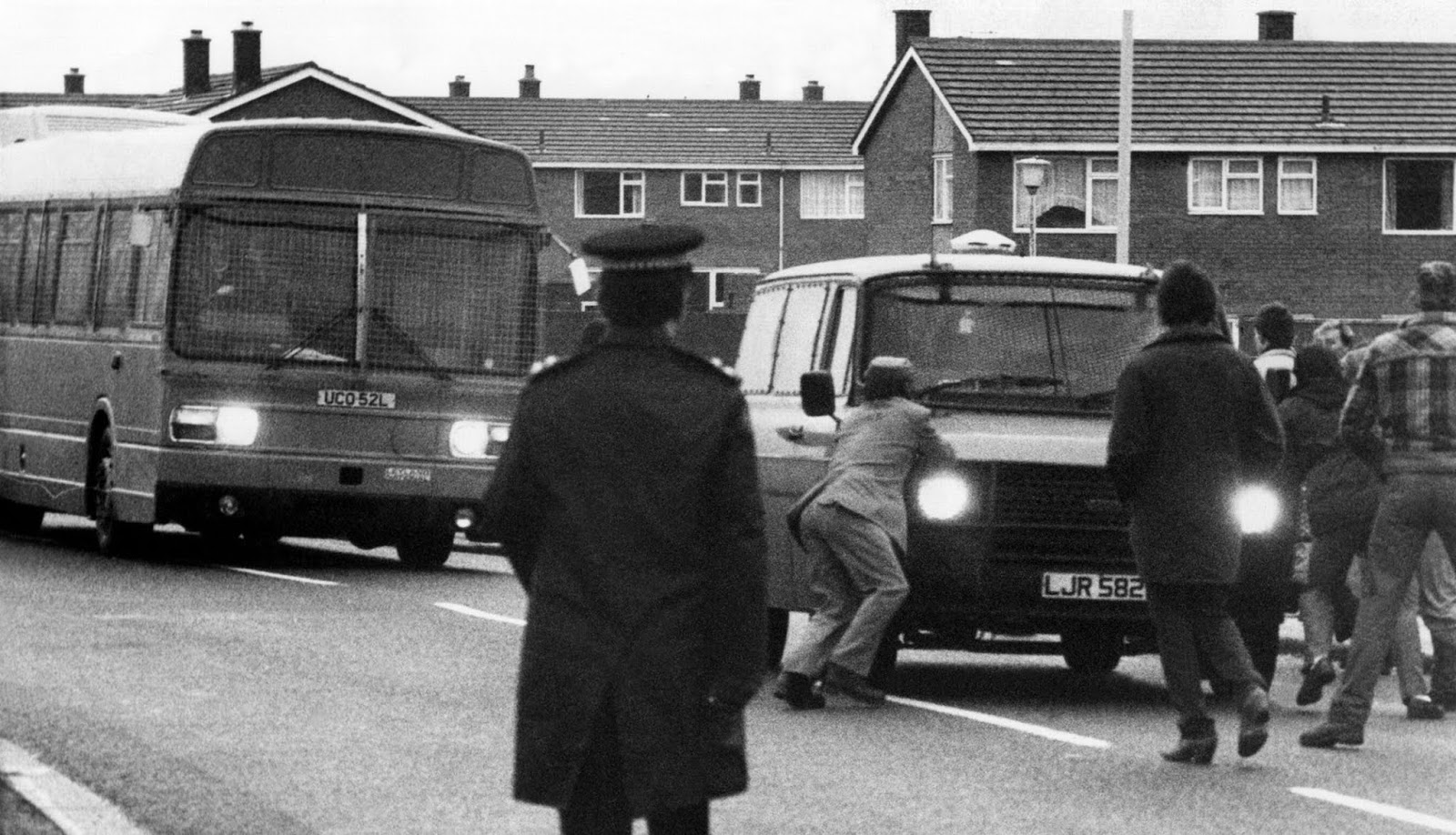
The site where the Battle of Orgreave happened in June 1984 is now covered by a kind of country park with shale tracks. Next to it are hundreds of newly built homes and it backs onto the Advanced Manufacturing Park, where I work.


There's plenty to say about Orgreave, but I wasn't there. I wasn't even in the area at that time and only saw it playing out on TV. Now, over 30 years later, it seems like ancient history - the iconic photographs of the time are in black and white and society seems to have moved on. But has it?

Thanks to Ian Duhig for helping to finish the poem.  

Orgreave

I weave through the
short cut, the rat run,
where the men ran
from mounted batons.

Narrow, winding roads
bear the brunt
of muscular 4x4s
that now taxi kids
to school

over land that saw
the fist of State
crash into the face
of Justice.

Lives pass in perfect
box houses
and dogs are walked
on red tracks, sniffing
as if they smell the
long dried blood.

Where tabloids spun
their web of lies
the turbines spin;
the memories
are fading now
to black and white

The pit wheels stopped
but turning still
the old film reel
the men in graves
until history proves
just who was right

Tim Fellows 2018

The Colours of Her Skirt

Based on a memory, which may be unreliable, from some time in the 1960s.  With thanks to Sarah Wimbush and Ian Parks for editing and for the...